

Condo vs HDB Singapore is one of the most common comparisons buyers make when deciding what type of home best suits their finances, lifestyle and long-term plans. HDB flats generally offer a more accessible route to home ownership, while private condominiums can provide additional facilities, fewer ownership restrictions and a different residential environment. However, the better choice depends on much more than whether a buyer prefers a swimming pool or a lower purchase price. This guide compares affordability, ownership rules, facilities, location, financing, maintenance costs, resale considerations and everyday lifestyle to help buyers make a more informed decision.
There is no property type that automatically suits every household. A young couple buying their first home may have very different priorities from an HDB upgrader, a family with several children or someone who values private facilities. Financial flexibility also matters because spending more on housing can affect savings, investments and other household goals. Therefore, buyers should compare the complete ownership experience rather than judging either option from its purchase price alone.
Condo vs HDB Singapore: Understanding the Basic Difference
HDB flats form part of Singapore’s public housing system and come with eligibility and ownership conditions administered by the Housing & Development Board. Buyers can purchase new flats directly from HDB when eligible or purchase resale flats from existing owners on the open market. Depending on the flat and buyer profile, households may also qualify for housing grants and other forms of housing support. These factors can make HDB ownership attractive to buyers who want to manage their housing costs while maintaining access to established neighbourhood amenities.
Private condominiums, by comparison, come from private property developers and function as private residential properties. They usually include shared facilities such as swimming pools, gyms, landscaped grounds and security features that residents collectively fund through maintenance contributions. Buyers generally have more flexibility around private-property ownership, although financing rules, stamp duties and other regulations still apply. Private condo prices can also vary considerably depending on tenure, location, age, project quality and market demand.
Executive Condominiums sit between these two categories and can be relevant to buyers comparing an HDB flat with a private condo. They begin with eligibility and ownership restrictions similar to subsidised housing before gradually transitioning toward private-property status. Because of this hybrid structure, some HDB upgraders consider ECs when they want condo-style living without immediately moving into a standard private development. Project-specific rules still matter, particularly following recent changes to EC income ceilings and Minimum Occupation Period requirements. (Housing & Development Board)
How Different Are the Purchase Prices?
Purchase price is usually one of the first differences buyers notice. HDB flats typically provide a lower entry point than private condominiums of comparable size, although prices depend heavily on location, flat type, remaining lease and whether the buyer chooses a new or resale flat. Premium HDB locations can still command substantial prices, especially when units offer desirable attributes such as MRT access, larger layouts or central locations. Therefore, buyers should compare actual properties rather than assuming every HDB flat is inexpensive.
Private condominium pricing reflects a different market. Buyers pay for the private land or leasehold interest, development specifications, shared facilities and the broader demand for private residential property. A compact new-launch condo in a desirable area may cost considerably more than a larger HDB flat in another neighbourhood. As a result, buyers should compare not only price per square foot but also total purchase quantum and usable living space.
Higher property prices can affect more than the initial downpayment. Larger loans may create higher monthly repayments and leave less room for savings, childcare, retirement planning and unexpected expenses. Buyers should calculate how comfortable the mortgage remains if interest rates or household circumstances change. A property that technically fits the maximum available financing may not necessarily provide the healthiest long-term budget.
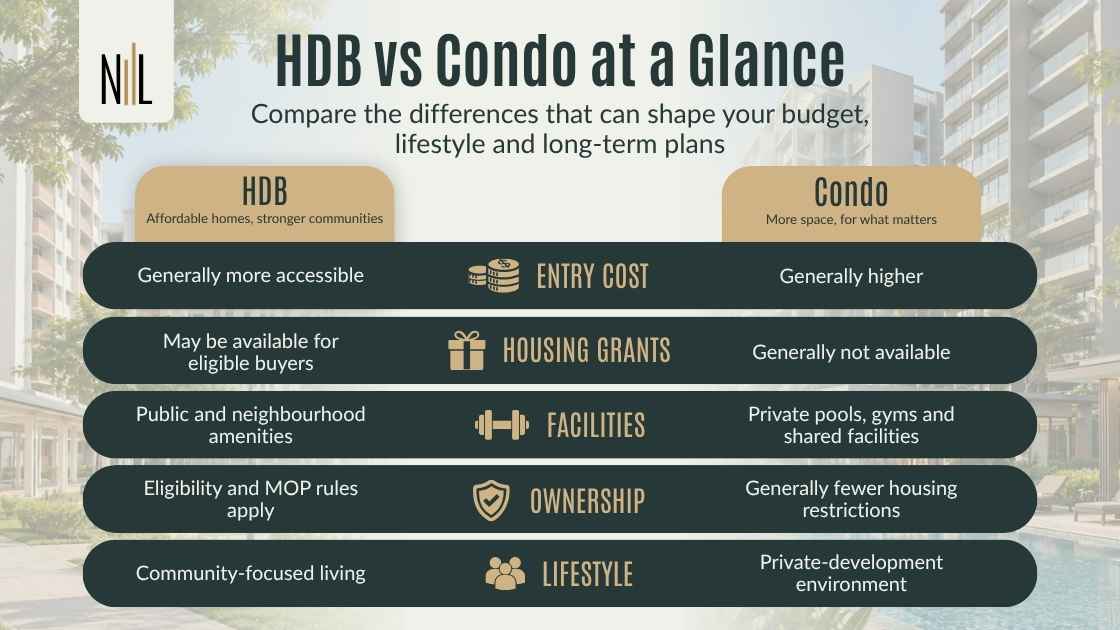
Condo and HDB Differences at a Glance
The following comparison provides a broad overview of how the two property types differ. Individual projects, HDB classifications and buyer circumstances can change the details, so buyers should confirm the rules that apply to the particular property they intend to purchase. Still, the table provides a useful starting point before moving into more detailed research. It also highlights why the decision involves considerably more than facilities alone.
| Factor | HDB Flat | Private Condo |
| Typical Entry Cost | Generally more accessible | Generally higher |
| Housing Grants | May be available to eligible households | Generally not available |
| Shared Facilities | Mainly neighbourhood and public facilities | Usually private development facilities |
| Security | Depends on development and precinct | Often includes controlled access or security |
| Maintenance | HDB-related service and conservancy charges | Monthly condo maintenance contributions |
| Ownership Restrictions | HDB eligibility and occupation rules apply | Generally fewer housing eligibility restrictions |
| MOP | Applies according to flat type and classification | No HDB MOP |
| Property Management | Town council and HDB-related frameworks | Management corporation after strata setup |
| Unit Size | Often competitive for the purchase price | Varies significantly by project |
| Lifestyle | Community and neighbourhood focused | Private-development environment |
One important distinction involves HDB’s Minimum Occupation Period. Standard and older unclassified HDB flats generally have a five-year MOP, while Plus and Prime flats come with longer 10-year MOP requirements under the newer classification framework. Owners must satisfy the applicable MOP before selling their flat or acquiring a private residential property, subject to the prevailing rules. Buyers who expect their housing needs to change within a few years should consider this restriction before purchasing. (Housing & Development Board)
Which Option Is More Affordable Month to Month?
Monthly affordability depends on more than the mortgage. HDB owners generally pay service and conservancy charges, while condo owners contribute maintenance fees for the upkeep of common property and private facilities. These condo contributions help fund items such as lifts, landscaping, security, pools, gyms and other shared infrastructure. Consequently, buyers should include recurring maintenance costs when comparing the two property types.
Condominium maintenance costs vary by development and unit share value. Projects with extensive facilities or more elaborate common areas may require higher ongoing contributions, while simpler developments can have lower fees. Buyers should ask about current maintenance charges when evaluating a resale condo and review indicative fees for a new launch where available. These payments continue whether or not the household regularly uses the facilities.
HDB households also face recurring housing expenses, including utilities, home insurance and maintenance within the flat. However, the overall monthly property-related commitment can still be lower when the purchase price and associated financing are lower. A household should therefore calculate the complete monthly cost for each option before deciding. Looking only at the mortgage can underestimate the actual difference.
What Lifestyle Do You Want?
Lifestyle is one of the strongest reasons buyers consider moving from an HDB flat to a condominium. Private condos often provide residents with facilities within the development, which may include swimming pools, gyms, function rooms, children’s play areas and landscaped spaces. Families that frequently use these amenities may value the convenience of having them close to home. In contrast, residents who rarely use shared facilities may question whether the additional purchase and maintenance costs provide enough value.
HDB living relies more heavily on shared neighbourhood infrastructure. Residents may have easy access to parks, community clubs, playgrounds, hawker centres, supermarkets and sports facilities that serve the wider public. Established HDB towns can therefore provide excellent everyday convenience without requiring residents to pay private-development maintenance charges. For some households, being close to a market, MRT station and school may matter more than having a pool downstairs.
Privacy preferences can also influence the decision. Condominiums often have controlled access and smaller residential communities within individual developments. HDB estates generally create a more open environment connected directly to surrounding public spaces. Neither arrangement is inherently better, so buyers should consider which setting feels more suitable for their household.
How Important Is Location?
Location can sometimes matter more than property type. A well-located HDB flat next to an MRT station may provide a shorter commute than a private condo that requires a bus connection. Similarly, an older private condominium in an established neighbourhood may offer better access to schools and shops than a newer project farther away. Buyers should therefore avoid assuming that upgrading to a condo automatically means upgrading convenience.
Daily routines provide a useful way to compare locations. Think about travel to work, school, childcare, groceries, healthcare and family members you visit regularly. A few additional minutes of travel may seem minor during a weekend viewing but can become significant when repeated every weekday. Buyers should test actual routes rather than relying solely on straight-line distance or marketing descriptions.
Future infrastructure can also influence location decisions, particularly in neighbourhoods undergoing transformation. However, buyers should separate officially announced plans from speculative future benefits. New MRT connections, commercial hubs and employment areas can improve convenience without guaranteeing a particular level of property appreciation. Location should first work for the household’s actual lifestyle.
Which Property Gives You More Space?
HDB flats can offer attractive space efficiency relative to their purchase price, particularly when comparing older flats with compact new private developments. However, layouts vary significantly according to the flat’s age, type and design generation. Some households may prefer the straightforward proportions of an HDB layout over a condo unit that allocates more floor area to balconies or private lift areas. Buyers should study floor plans rather than relying only on the stated floor area.
Private condominiums offer a much wider variety of layouts and sizes. New launches may include compact one-bedroom units through to large family homes, while older developments can have considerably larger floor plans. Buyers should look at bedroom dimensions, storage, circulation space and kitchen functionality when comparing units. An efficient smaller home can sometimes function better than a larger property with substantial unusable space.
Household changes should also influence the decision. A couple may need only two bedrooms today but could require more space for children, parents or home working later. Moving property repeatedly creates transaction costs and disruption, so some buyers choose a home that allows room for future changes. The ideal amount of space should balance future flexibility against today’s affordability.
What About Housing Grants?
Housing support represents an important difference between public and private housing. Eligible HDB buyers may qualify for CPF Housing Grants depending on the type of purchase and their household circumstances. The exact grant amount and eligibility conditions can change according to prevailing policies, so buyers should use official HDB information when planning their budget. Grants can meaningfully affect affordability but should never be assumed before eligibility has been confirmed.
Private condominium purchases generally do not come with the CPF Housing Grants available for subsidised public housing purchases. Buyers may still use eligible CPF savings toward private residential property subject to CPF rules, but this should not be confused with receiving a housing grant. As a result, households moving into private property may need to rely more heavily on their own funds and financing. This difference can influence how quickly a household can comfortably upgrade.
Executive Condominiums create another consideration because eligible first-timer households buying qualifying new EC units may receive CPF Housing Grants. However, EC eligibility and ownership restrictions apply, and the precise conditions can differ from standard private condominiums. Buyers who want private-condo-style facilities but remain eligible for an EC may therefore want to compare all three housing routes. The right choice depends on both household eligibility and financial priorities. (Housing & Development Board)
What About MOP and Ownership Flexibility?
HDB ownership comes with a Minimum Occupation Period that affects when owners can sell the flat and when they may acquire private residential property. For Standard and older unclassified flats, the MOP generally remains five years, while newer Plus and Prime classifications carry a 10-year MOP. The calculation can also exclude periods when owners did not physically occupy the flat under certain circumstances. Buyers should understand the applicable MOP before assuming they can upgrade whenever they choose. (Housing & Development Board)
Private condominium owners do not face the same HDB Minimum Occupation Period. This gives owners greater flexibility to sell or change their housing arrangement, although transaction costs, financing conditions and tax considerations still matter. Seller’s Stamp Duty may also apply depending on the holding period and prevailing rules. Greater flexibility therefore does not mean every short-term transaction makes financial sense.
The distinction becomes particularly important for households expecting major changes. Someone considering overseas relocation, family expansion or another property purchase within several years may value flexibility more highly. Conversely, a household intending to remain in the same home for a long period may view an MOP as less significant. Buyers should connect ownership rules to their own likely timeline.
How Do Stamp Duties Affect the Comparison?
Both HDB and condo buyers can face Buyer’s Stamp Duty when acquiring residential property. Additional Buyer’s Stamp Duty depends on factors including citizenship and the number of residential properties owned. Under current rates, Singapore Citizens do not pay ABSD on their first residential property, while a second residential property currently attracts a 20% ABSD rate for an SC buyer. Singapore Permanent Residents and foreigners follow different rate structures. (Default)
This becomes especially relevant when an existing HDB owner considers purchasing a private condominium. Owners generally need to satisfy the HDB MOP before acquiring private residential property, while ABSD considerations depend on the ownership situation at the time of purchase. A household considering an upgrade should therefore plan the sale and purchase sequence carefully. Professional legal and financial advice may also help when the transaction becomes more complex.
Stamp duties should form part of the affordability calculation rather than appearing as an unexpected cost after choosing a property. Buyers should also check the latest IRAS rules immediately before purchasing because tax policies can change. Using current official rates is more reliable than relying on figures from older property articles. This is particularly important when comparing upgrade strategies.
How to Decide Between an HDB Flat and a Condo
Choosing between the two becomes easier when buyers turn broad preferences into specific household priorities. The process should consider finances first, followed by practical lifestyle requirements and longer-term plans. Buyers can then compare real properties rather than debating HDB versus condo in the abstract. The following approach provides a simple framework for reaching a more practical decision.
- Set a comfortable total budget.
Calculate available CPF funds, cash, potential borrowing capacity and monthly repayment before deciding what property category to target. Include stamp duties, legal expenses and recurring ownership costs rather than looking only at the advertised purchase price. Most importantly, leave room for savings and other household expenses after the purchase. - List the features you genuinely use.
Consider whether a swimming pool, gym, security system or landscaped grounds would meaningfully improve your household’s lifestyle. If these facilities receive regular use, paying for a condo may feel more worthwhile. However, buyers who primarily value transport, schools and space may find that a well-located HDB flat serves them just as effectively. - Compare actual locations.
Shortlist properties based on commuting time, MRT access, schools, shopping and daily services. Avoid comparing an idealised condo lifestyle with HDB housing as a whole because individual developments vary considerably. A specific HDB flat may outperform a specific condo on several practical criteria. - Consider your five-to-ten-year plans.
Think about children, elderly parents, job changes, overseas moves and future property goals. Housing that fits today’s household but becomes unsuitable within two years can create unnecessary costs. Ownership restrictions should also fit comfortably within your likely timeline. - Compare real units before deciding.
Once the budget and priorities are clear, visit both HDB and condo options within the same general price or location range where possible. Compare space, layout, environment and total cost rather than focusing only on property labels. Real-world comparison often makes the final choice much clearer.
When Might an HDB Flat Be the Better Choice?
An HDB flat may suit buyers who prioritise affordability, internal space and access to established neighbourhood amenities. First-time buyers who qualify for housing grants can also benefit from support that is not generally available when buying a standard private condominium. Lower housing costs may leave more room in the household budget for investments, family expenses or other goals. For buyers who do not strongly value private facilities, this can represent a practical trade-off.
HDB can also work well for households that expect to stay in the same home for many years. In that situation, the MOP may have less impact on day-to-day life because the household already intends to remain in the property. Established towns can offer strong access to public transport, food, schools and healthcare without the premium associated with private developments. Buyers should still choose the specific flat carefully because lease age, location and condition can significantly affect value.
The main question is whether public-housing restrictions interfere with the buyer’s plans. Households that expect to acquire another residential property soon or need greater ownership flexibility may find these restrictions more important. Meanwhile, buyers focused primarily on creating a stable long-term home may be comfortable with them. Personal circumstances matter more than the perception that one housing category is inherently superior.
When Might a Condo Be the Better Choice?
A condo may suit households that can comfortably manage the higher purchase and ongoing costs while genuinely valuing the lifestyle benefits. Private facilities, controlled access and the overall development environment can make a meaningful difference for residents who use them regularly. Buyers may also value the broader range of unit types and locations available within the private market. In addition, the absence of an HDB MOP provides more flexibility for future property decisions.
Some HDB upgraders also view a condominium as the next stage of their housing journey after building sufficient equity and savings. However, upgrading should not become an automatic financial goal simply because household income has increased. Buyers should compare how much additional value the condo provides relative to the increase in purchase price and recurring costs. A larger mortgage should support a meaningful improvement in living needs rather than simply a change in property label.
Resale potential is another consideration, but buyers should remain realistic. Private property can attract a wider pool of buyers than subsidised housing in some circumstances, yet future prices still depend on supply, demand, location, property condition and broader market conditions. No property type guarantees appreciation. Buyers should first make sure the home works as a place to live.
What About Executive Condominiums?
For eligible households, an Executive Condominium can provide another route between HDB and standard private-condo ownership. EC developments typically provide condominium-style facilities while operating under eligibility and ownership rules during the earlier stages. Some first-timer households may also qualify for CPF Housing Grants when purchasing a new EC directly from a developer. As a result, ECs often attract HDB upgraders who want to explore private-style living while remaining within the EC framework.
However, buyers need to check the rules for each project carefully. New EC sites can follow different income ceilings and MOP requirements depending on when their land sales tenders closed. For example, HDB states that new EC units in projects with tenders closing on or after 24 August 2026 have an S$18,000 monthly household income ceiling, while sites from earlier tenders retain the previous S$16,000 ceiling. EC sites with tenders closing on or after 8 May 2026 also come under the newer 10-year MOP framework. (Housing & Development Board)
Buyers researching upcoming EC options may encounter Wynwood Grand at Woodlands Drive 17. Comparing its project-specific eligibility framework, location, pricing information and expected unit mix against both HDB and private-condo alternatives can help households decide which route suits them better. This type of comparison is especially relevant to existing HDB owners considering their first step into condominium-style living. Buyers should still wait for confirmed developer information where project details remain pending.

So, Which Is Better for You?
There is no universal winner in the condo vs HDB Singapore decision. HDB flats can provide stronger affordability and access to housing support, while private condominiums may offer additional facilities, ownership flexibility and a different residential environment. The better property is the one that supports your household without putting unnecessary pressure on your finances. Buyers should therefore compare real homes based on their total cost, location, layout and long-term suitability.
For many households, the answer may also change over time. An HDB flat can make sense during one stage of life, while a condo or EC may become more suitable after finances, household size and priorities change. Property ownership should support those changes rather than becoming a competition to move into the most expensive category possible. A clear understanding of what each option offers makes the decision much easier.
Find the Right Home for Your Next Move
Choosing between an HDB flat, private condominium and Executive Condominium becomes easier when you understand how each option fits your budget, lifestyle and future plans. New Launch Condo provides property guides, neighbourhood insights and updates on upcoming residential developments across Singapore to help buyers research their choices before making major commitments. Compare new projects, explore different housing options and learn more about the factors that can affect your next purchase. Visit New Launch Condo for the latest guides and project updates before deciding which type of home deserves a place on your shortlist.