
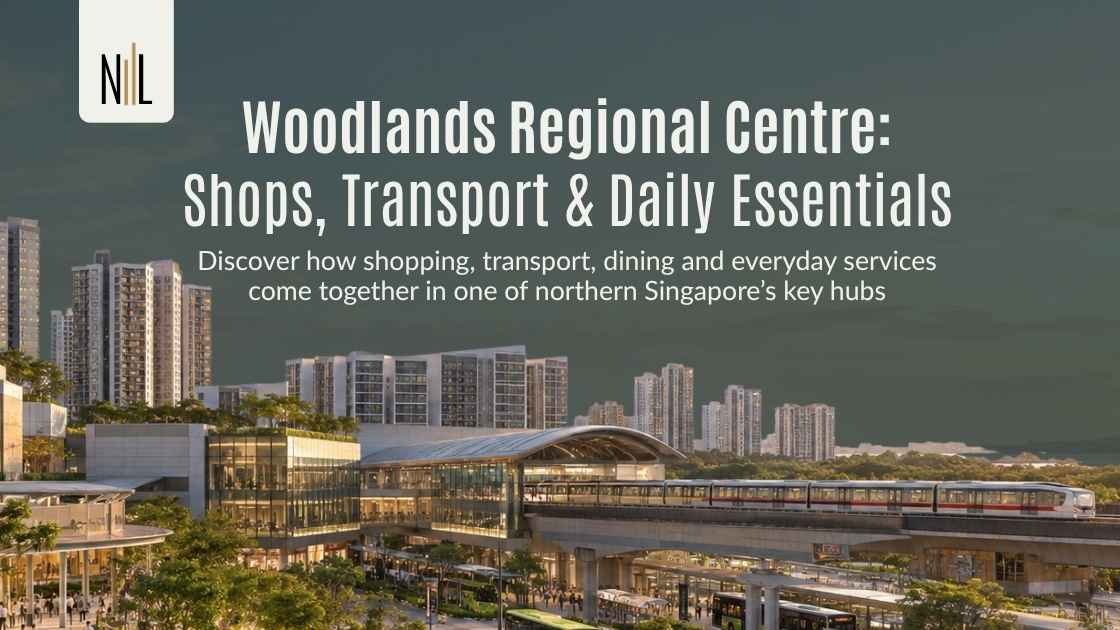
Woodlands Regional Centre is developing into one of the most important commercial and lifestyle hubs in northern Singapore, bringing together shopping, transport, offices, dining and everyday services in one connected district. For residents in Woodlands and nearby neighbourhoods, the area already provides access to major retail centres, MRT connections, bus services, banks, healthcare services and a wide range of food options. At the same time, further development is expected to strengthen its role as Singapore’s Northern Gateway and create more opportunities for people to live, work and spend time closer to home. This guide looks at the practical side of the area, including where to shop, how to get around and where residents can find useful everyday services. (Urban Redevelopment Authority (URA))
URA describes the regional centre as the economic hub of Singapore’s Northern Gateway, with Woodlands Central serving as its main commercial node. The wider area is planned to include a mix of office, retail, industrial, residential and community uses, supported by improved pedestrian connections. As development continues, residents can expect the district to become more integrated rather than functioning only as a transport interchange or shopping destination. This makes it increasingly relevant to both existing residents and buyers considering homes in northern Singapore. (Urban Redevelopment Authority (URA))
Woodlands Regional Centre Shopping and Retail Options
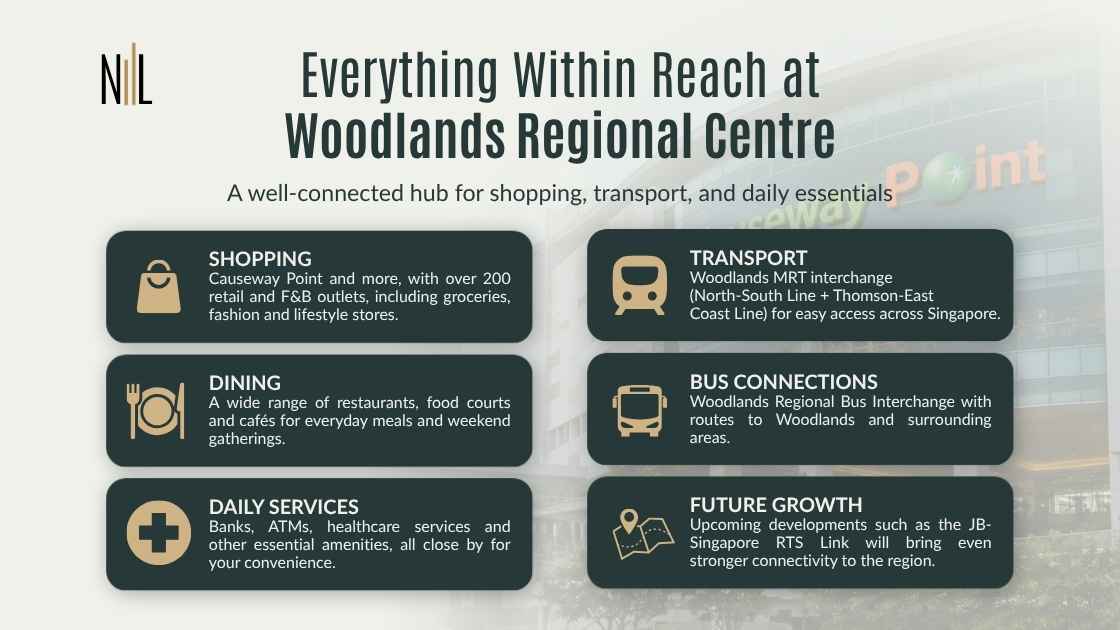
Shopping is already one of the strongest reasons people visit the area. Causeway Point remains the major retail destination in Woodlands and sits directly within the regional centre near Woodlands MRT and the bus interchange. The mall has more than 200 retail and food and beverage outlets, giving residents access to fashion, groceries, electronics, household goods and dining in one location. Major tenants include FairPrice Finest, Uniqlo, Metro and Courts, which makes the mall practical for both everyday errands and larger purchases. (Causeway Point)
Causeway Point is especially useful because it combines essential retail with entertainment and dining. Residents can complete grocery shopping, buy household items, visit restaurants and browse fashion stores without travelling into central Singapore. Its direct connection with public transport also makes it convenient for people arriving from surrounding neighbourhoods. For many households, this reduces the need to make separate trips for different errands.
Woods Square adds another layer to the area by bringing offices and commercial activity closer to the existing retail cluster. Located next to Causeway Point and Woodlands Civic Centre, it supports the wider shift toward a more mixed-use business district. As more office and commercial spaces develop across the regional centre, the range of shops and services can expand further to serve both residents and workers. URA’s long-term plans specifically position Woodlands Central as the core office and retail node of the North. (Urban Redevelopment Authority (URA))
Where Can Residents Buy Electronics and Household Essentials?
Electronics and household goods are easy to find around the main shopping cluster. Causeway Point includes retailers such as Courts, alongside stores selling mobile devices, accessories and other consumer electronics. This gives residents a convenient option for buying appliances, technology products and home essentials without travelling far from Woodlands. (Causeway Point)
Beyond electronics, the mall also supports routine household shopping through supermarkets, personal-care retailers and general merchandise stores. Having these services concentrated near the MRT station makes it easier for commuters to complete errands before heading home. In addition, nearby commercial developments continue to add services that support the working population around Woodlands Central. The result is a district that functions as more than a conventional suburban shopping area.
Getting to Woodlands Regional Centre by MRT
Public transport is one of the area’s biggest advantages. Woodlands MRT is an interchange serving both the North-South Line and Thomson-East Coast Line, allowing passengers to travel toward different parts of Singapore without relying entirely on buses or private vehicles. The station forms part of the Woodlands Integrated Transport Hub, which connects rail services with the regional bus interchange. (Urban Redevelopment Authority (URA))
The North-South Line provides a direct connection toward areas such as Yishun, Ang Mo Kio, Orchard and the city. Meanwhile, the Thomson-East Coast Line expands connectivity toward destinations including the central and eastern parts of Singapore. This combination gives Woodlands a stronger transport position than areas served by only one MRT line. For residents who commute regularly, having access to both lines increases flexibility when planning daily journeys.
Cross-border connectivity is also becoming increasingly important. URA states that the regional centre will benefit from the Johor Bahru-Singapore Rapid Transit System Link and the future redevelopment of Woodlands Checkpoint. The RTS Link is targeted for completion by the end of 2026, while the redeveloped checkpoint is expected to become progressively operational from 2029. These developments are expected to strengthen Woodlands’ role as a connection point between Singapore and Johor Bahru. (Urban Redevelopment Authority (URA))
Bus and Road Transport Around Woodlands
The Woodlands Regional Bus Interchange sits alongside the MRT network and serves residents travelling within Woodlands and to neighbouring towns. Bus services are particularly useful for reaching residential areas that sit farther from MRT stations, as well as schools, parks and community facilities. Because the interchange connects directly with Causeway Point and Woodlands MRT, commuters can switch between bus and rail services without travelling to a separate transport hub. (Causeway Point)
Road connections also support travel toward other parts of northern Singapore and the Causeway. Drivers can access major roads serving Woodlands, while buses provide connections to nearby neighbourhoods and key destinations. However, cross-border traffic can vary considerably, especially around peak travel periods. Residents who frequently travel toward Malaysia may therefore benefit from having multiple transport options available.
URA also plans additional transport infrastructure within the wider regional centre. A future multimodal transport hub at Woodlands Gateway is expected to include another bus interchange and improve transfers between different forms of transport. As these connections develop, the district should become easier to navigate for residents, workers and visitors. (Urban Redevelopment Authority (URA))
Shopping, Transport and Daily Services at a Glance
The table below summarises the main types of amenities available around the regional centre. It is intended as a practical guide rather than a complete tenant directory, since individual businesses and operating hours can change over time.
| Need | Main Options Around the Area | Why It Is Useful |
| Shopping | Causeway Point and surrounding Woodlands Central retail | Groceries, fashion, household goods and everyday shopping |
| Electronics | Electronics and appliance retailers within Causeway Point | Convenient access to devices, appliances and accessories |
| MRT | Woodlands MRT Interchange | Access to North-South and Thomson-East Coast Lines |
| Bus | Woodlands Regional Bus Interchange | Connections across Woodlands and surrounding areas |
| Dining | Restaurants, food courts and casual dining around Woodlands Central | Options for daily meals and evening dining |
| Banking | Bank branches, ATMs and financial services around the commercial centre | Convenient access to everyday banking |
| Healthcare | Clinics and healthcare providers within the wider Woodlands area | Routine consultations and health services |
| Future Connectivity | JB-SG RTS Link and future multimodal transport hub | Stronger local and cross-border connectivity |
Where Can You Find Banks and Financial Services?
Residents can find banking services around the established commercial areas of Woodlands Central, particularly near the MRT station and major retail developments. Major shopping and business centres typically provide access to ATMs, banking machines and selected physical bank branches. This allows residents to handle many routine financial tasks while completing other errands in the area.
However, physical branch networks can change as banks consolidate or relocate outlets. Anyone who needs a particular service, such as mortgage consultation, document certification or business banking, should check the bank’s latest branch information before travelling. Digital banking has reduced the need for physical branches, but access to ATMs and service counters remains useful for many households. The concentration of retail and office activity around Woodlands Central makes it one of the more practical places in the north to find these services.
Where Can Residents Go for Dinner?
Dining choices around Woodlands Central range from food courts and casual restaurants to cafés and takeaway options. Causeway Point serves as the main concentration of food and beverage outlets, making it convenient for families, workers and commuters who want dinner before heading home. Its location beside the MRT and bus interchange also means diners do not necessarily need a car to reach the area. (Causeway Point)
The variety of dining formats makes the area suitable for different occasions. Families may prefer restaurants that can accommodate larger groups, while commuters may choose food courts or quick-service options after work. Cafés and casual eateries also provide places for meetings or relaxed weekend meals. As the regional centre continues to develop, additional office and retail projects may further increase the number of dining choices available.
For residents, the advantage is not simply having many restaurants. The stronger benefit comes from combining dinner with other activities such as grocery shopping, banking or commuting. This type of mixed-use convenience is part of URA’s broader vision for Woodlands Central as a pedestrian-friendly commercial hub. (Urban Redevelopment Authority (URA))
Where Can Residents Find Clinics and Health Services?
General healthcare services are available across the wider Woodlands area, including neighbourhood clinics and medical providers around major residential and commercial clusters. Residents looking for general consultations, basic health screenings or routine medical services can usually find options without travelling into central Singapore. However, the exact services offered differ between clinics, so patients should confirm whether a provider offers health screening before making an appointment.
The wider Woodlands district also benefits from its growing healthcare infrastructure. For home buyers, proximity to healthcare can become increasingly important when considering long-term family needs, particularly for households with young children or older parents. Access to routine clinics complements the broader medical facilities available within northern Singapore. As a result, healthcare forms part of the practical everyday appeal of living in the area.
How Easy Is It to Complete Daily Errands?
The strongest advantage of Woodlands Central is the concentration of multiple services within a relatively compact commercial area. A resident can arrive by MRT, buy groceries, have dinner, use banking services and shop for household essentials before returning home. This reduces the need to travel to separate neighbourhoods for different everyday needs. The integration between transport and retail also makes the area particularly useful for households that do not rely heavily on a car.
For commuters, this can make weekday routines more efficient. Instead of travelling home and then making another trip for groceries or dinner, residents can complete errands while passing through the transport interchange. Families may also find the area useful on weekends because shopping, dining and other services sit close together. This level of convenience is one reason regional centres play an important role in Singapore’s decentralisation strategy.
What Is Planned for the Future?
The regional centre is still developing, which means today’s retail and transport options represent only part of the longer-term plan. URA describes the area as an economic hub that will include office, retail, industrial, residential and community spaces across several precincts. Woodlands Central will continue serving as the main office and retail node, while Woodlands Gateway is planned as an employment and manufacturing hub with stronger cross-border connectivity. (Urban Redevelopment Authority (URA))
Future development will also place greater emphasis on pedestrian connections and public spaces. URA plans sheltered pedestrian networks at multiple levels within Woodlands Central, alongside cycling routes and links between transport facilities, commercial developments and public spaces. These improvements aim to make the district easier to navigate without relying entirely on cars. (Urban Redevelopment Authority (URA))
The regional centre forms part of a wider transformation of northern Singapore. URA expects additional spaces for industry, research, development, learning and innovation to emerge over the coming years. For residents, this could mean more jobs, services and amenities located closer to home rather than concentrated in the city centre. (Urban Redevelopment Authority (URA))
How to Make the Most of a Visit
Visitors who want to explore the district efficiently can use a simple route that combines the main transport and commercial areas. This approach works particularly well for someone who is considering living nearby and wants to understand what everyday life around the regional centre actually feels like.
- Start at Woodlands MRT Interchange. Arriving by MRT gives you an immediate sense of how the North-South and Thomson-East Coast Lines connect with the surrounding commercial district. From there, you can also see how the bus interchange fits into the overall transport network.
- Walk through Causeway Point. Explore the supermarket, restaurants, electronics retailers and general shops to understand what everyday shopping options are available. This is also a good opportunity to see how easily commuters can combine shopping with their journey home.
- Explore Woodlands Central and nearby commercial buildings. Walking around Woods Square, Woodlands Civic Centre and neighbouring developments gives a broader picture of the area’s business and community functions. It also helps visitors understand how the regional centre extends beyond the shopping mall itself.
- Check the surrounding residential connections. If you are considering buying or renting nearby, look at the actual walking and bus routes from residential areas rather than relying only on map distances. Everyday convenience often depends on the quality of the route, crossings and transport connections.
- Return during a different time of day. A weekday evening can feel very different from a weekend afternoon, particularly around transport interchanges and dining areas. Visiting more than once provides a better sense of crowd levels and everyday activity.
What Does This Mean for Home Buyers in Woodlands?
For home buyers, a regional centre can influence more than shopping convenience. Access to employment areas, public transport, retail and healthcare can shape how practical a neighbourhood feels over the long term. Buyers may therefore want to consider not only the distance from a home to Woodlands Central but also how easily they can reach the MRT, shops and surrounding amenities.
Upcoming residential developments in the wider Woodlands area can benefit from this established and expanding infrastructure. One development buyers may encounter during their research is Wynwood Grand EC at Woodlands Drive 17, which is positioned within the broader Woodlands growth story. Buyers evaluating the project can consider its connectivity to Woodlands South MRT together with access to Woodlands Central and the wider northern region.
The ongoing development of the north does not guarantee property-price performance, and buyers should avoid treating future planning announcements as automatic investment returns. However, infrastructure, employment opportunities and everyday amenities remain relevant when comparing locations. Looking at these practical factors can help buyers decide whether a neighbourhood suits their household rather than focusing only on the property’s launch price.
Is Woodlands Regional Centre Convenient for Everyday Living?
Overall, the area already provides a strong combination of transport, retail and everyday services. Residents can access two MRT lines at Woodlands Interchange, a regional bus interchange, a major shopping mall and numerous food and retail options within the central commercial cluster. Future developments are expected to add more workplaces, connectivity and mixed-use spaces over time. (Urban Redevelopment Authority (URA))
The location may be especially practical for households that spend most of their time in northern Singapore or frequently travel toward Johor Bahru. At the same time, direct rail connections provide access toward the rest of Singapore, reducing some of the traditional concerns about living farther from the city centre. Buyers and renters should still consider their individual workplaces, schools and regular destinations before deciding whether the area suits them.
Discover More About Living and Buying in Northern Singapore
Understanding an area before choosing a property means looking beyond the development itself. Shopping, transport, healthcare, dining and future infrastructure all influence how convenient a neighbourhood feels after moving in. New Launch Condo provides guides, market updates and information on new residential projects across Singapore to help buyers compare locations and understand what different neighbourhoods can offer. Explore our latest area guides and new-launch property updates to discover projects and locations that may suit your next move.