
Executive condo Singapore buyers need to understand the full application process before choosing a unit or committing to a purchase. Buying a new Executive Condominium involves more than comparing prices, floor plans and locations because applicants must also meet specific eligibility, household income and property ownership requirements. Buyers should prepare their financing, understand the payment stages and check whether they qualify for CPF Housing Grants before booking a unit. This guide explains the entire process step by step so buyers can prepare earlier and avoid unnecessary problems during a new EC launch.
An Executive Condominium, commonly called an EC, combines private-condominium-style living with eligibility rules that apply during the earlier years of ownership. These conditions make the buying process different from purchasing a standard private condominium in Singapore. A household may have enough savings for the downpayment but still be unable to proceed if it does not meet the EC requirements. For this reason, buyers should always begin with eligibility and affordability before focusing on preferred units.
Who Can Apply for an Executive Condo?
Buyers should first confirm that their household meets the eligibility requirements for purchasing a new EC directly from a developer. Eligible applicants generally need to form an approved family nucleus, such as a married couple, engaged couple or parent-child household. In most cases, at least one applicant must be a Singapore Citizen, while another applicant must be either a Singapore Citizen or Singapore Permanent Resident. Groups of eligible singles may also apply under the applicable rules, although specific age and citizenship requirements apply.
Household income is another important requirement to check before submitting an application. The applicable income ceiling may depend on when the land tender for the EC site closed, which means different projects can follow different policy frameworks even if they launch around the same period. Buyers should therefore check the rules that apply to the specific development they are considering instead of assuming that every new EC uses the same income limit. This step is especially important when government policies change between land tender dates and actual project launches.
Applicants should also review existing property ownership restrictions carefully. Buyers and listed occupiers generally need to satisfy the prevailing rules concerning ownership of private residential property in Singapore or overseas. Waiting periods can also apply to households that previously disposed of private property. Checking these conditions early can prevent buyers from spending time comparing units in a project they may not currently qualify to purchase.
Prepare Your Finances Before Applying
Eligibility alone does not determine whether a household can comfortably afford an EC. Buyers should calculate the cash available, CPF Ordinary Account savings, expected loan amount and estimated monthly mortgage before entering the booking stage. Stamp duties, legal fees and other purchase-related costs should also form part of the affordability calculation. A realistic budget allows buyers to shortlist units more confidently when the developer releases pricing.
A bank’s In-Principle Approval can provide an early indication of how much the household may be able to borrow. Although an IPA does not guarantee final loan approval, it gives buyers a useful starting point for determining a suitable purchase budget. Households should avoid assuming that the maximum loan amount automatically represents a comfortable price range. Maintaining a financial buffer can help protect against changes in interest rates, household income and future family expenses.
Stamp duties can also have a significant effect on the total amount required. Buyer’s Stamp Duty generally applies to residential property purchases, while Additional Buyer’s Stamp Duty depends on factors such as citizenship, residency status and the number of residential properties already owned. Buyers should calculate these costs before deciding which unit price they can realistically manage. Doing so helps prevent a situation where the headline purchase price appears affordable but the total acquisition cost becomes unexpectedly high.
Executive Condo Singapore: Step-by-Step Application Guide
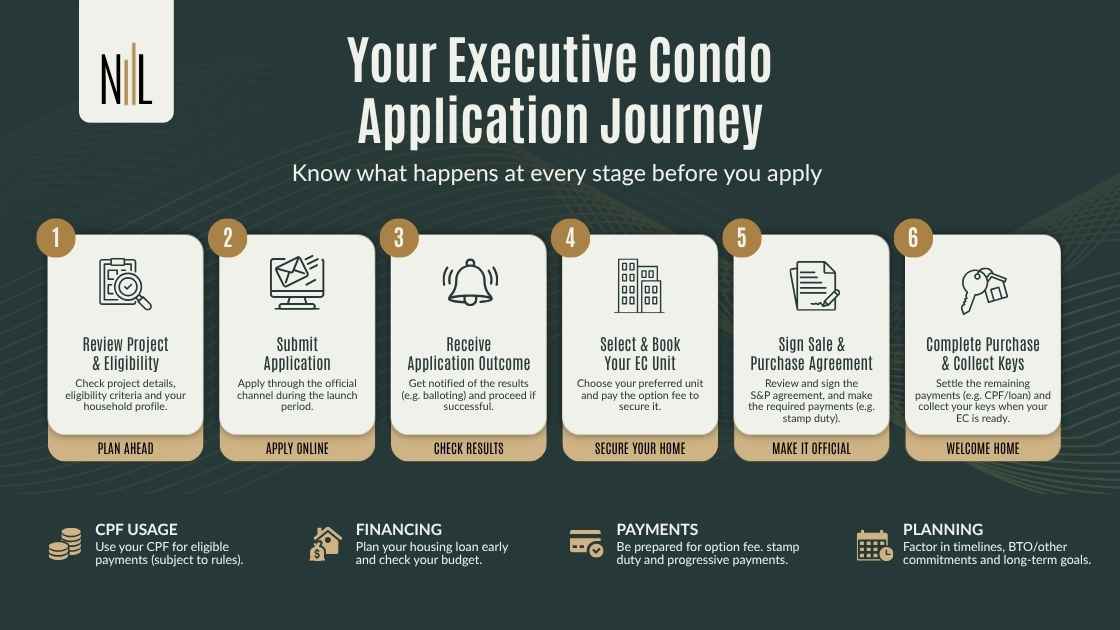
The general executive condo Singapore application process follows a clear sequence, although individual developers may manage their launches differently. Buyers who understand the stages beforehand can react more calmly when applications and unit booking begin. Preparing documents, financing and preferred units in advance also reduces the risk of making rushed decisions. The following steps outline how a typical new EC purchase progresses from project launch to completion.
- Review the project launch information.
Buyers should begin by studying the project’s location, estimated pricing, unit mix, floor plans, developer background and launch schedule. At this stage, compare the project with your household needs rather than focusing only on promotional materials. It is also useful to compare nearby developments and understand how the project fits within the wider area. - Submit the application to the developer.
Applications for new ECs are generally handled through the property developer rather than through the standard HDB flat application process. Buyers need to provide the information requested for eligibility assessment and follow the developer’s application timeline. Depending on demand, the developer may use balloting or another approved selection arrangement before unit booking begins. - Wait for the application outcome.
Successful applicants will receive further instructions about the booking process and available selection dates. Strong demand can mean that buyers do not receive their first preferred unit, particularly for popular layouts, stacks or floor levels. Preparing several suitable alternatives can therefore make the selection process less stressful. - Book an available EC unit.
Eligible applicants who receive a booking opportunity can choose from the units that remain available. Buyers generally pay an option fee when they successfully book the property and receive the Option to Purchase from the developer. This is also an important stage for applicants who intend to use an eligible CPF Housing Grant, as supporting documents may need to be prepared or submitted. - Sign the Sale and Purchase Agreement.
After booking, buyers should work with their solicitor and lender to complete the necessary legal and financial arrangements. The remaining portion of the downpayment becomes payable according to the stated schedule, while eligible CPF savings may help fund part of the purchase. Buyers should confirm every payment deadline carefully so they do not miss important contractual dates. - Complete the purchase and collect the keys.
Payments continue according to the applicable construction and purchase schedule until the development reaches completion. Once the project is ready for handover, the developer will arrange key collection with eligible owners. Buyers must then comply with the ownership and occupation requirements that apply to the EC.
What Payments Should Buyers Prepare For?
The initial booking payment forms only one part of the overall purchase commitment. Buyers need to prepare for several financial stages before and after signing the Sale and Purchase Agreement. Understanding the sequence helps households avoid concentrating all their attention on the initial downpayment while overlooking later costs. The table below provides a simplified overview of the main financial stages.
| Purchase Stage | Typical Financial Requirement |
| Before application | Budget planning, CPF review and loan assessment |
| Application stage | Depends on the developer’s process |
| Successful booking | Option fee based on the purchase price |
| Sale and Purchase Agreement | Balance of the required downpayment |
| Legal purchase process | Stamp duties, legal fees and related costs |
| Remaining purchase price | Housing loan, CPF and/or cash depending on financing |
The option fee forms part of the purchase price rather than an additional charge on top of the property value. Similarly, the balance downpayment contributes toward the total purchase amount. Buyers may be able to use eligible CPF savings during parts of the process, depending on the prevailing requirements and their available CPF balance. For this reason, households should review both their cash and CPF positions rather than looking at either source of funds in isolation.
Can Buyers Receive a CPF Housing Grant?
Some eligible first-timer households may qualify for a CPF Housing Grant when purchasing a new EC directly from a developer. The amount available can depend on household income, citizenship combination, first-timer status and the prevailing housing policies. Buyers should confirm their eligibility before assuming that the grant will form part of their purchase budget. Including an unconfirmed grant in affordability calculations can create problems later if the household does not qualify.
CPF Housing Grants do not operate like cash rebates that buyers can spend freely. Instead, the grant generally becomes part of the CPF funds used toward an eligible property purchase. Buyers should therefore understand how the grant interacts with the downpayment, CPF balance and loan amount. Reviewing this early can provide a clearer picture of how much cash may still be required during the purchase.
What Happens If the EC Is Oversubscribed?
Popular EC launches can receive more applications than the number of homes available. When this happens, applicants may need to go through a balloting or selection process before booking a unit. A successful application does not necessarily mean that a buyer will obtain the exact stack, floor level or layout originally preferred. Buyers should therefore prepare a shortlist of several acceptable options before selection begins.
For example, a household may prefer a four-bedroom unit on a higher floor with a certain orientation. If those units become unavailable before the household’s selection turn, having alternative stacks can help prevent rushed decision-making. Buyers should compare total price, floor level, facing, internal layout and proximity to facilities before finalising their backup choices. This approach gives buyers more flexibility when demand for particular units becomes strong.
Should You Arrange Financing Before Booking?
Buyers should understand their financing position before reaching the unit booking stage. An In-Principle Approval from a bank can provide a useful estimate of potential borrowing capacity and help establish a realistic purchase range. However, the final loan amount can still depend on the actual property, purchase price and the buyer’s financial circumstances at the time of approval. An IPA should therefore guide the budget rather than replace a full financial assessment.
Households should also avoid stretching their finances simply because a lender may offer a larger loan. Monthly mortgage payments need to remain manageable alongside household expenses, insurance, education costs and other long-term commitments. Interest rates may also change during the ownership period, which can affect monthly repayments. Leaving some financial flexibility can make the purchase more sustainable over time.
How Should Buyers Compare Different EC Projects?
Qualifying for an EC does not automatically mean that every EC project will suit the household equally well. Buyers should compare developments based on location, MRT access, nearby schools, healthcare facilities, shopping options, unit layouts and total purchase price. Future plans for the surrounding neighbourhood may also affect convenience and long-term appeal. Looking beyond the launch price can help buyers identify which project fits their lifestyle more closely.
Floor-plan efficiency deserves careful attention when comparing similar unit sizes. Two homes with similar floor areas can feel very different depending on bedroom proportions, balcony size, storage, circulation space and kitchen design. Buyers should also consider whether the layout can adapt as family needs change over the next several years. A slightly different layout may offer better long-term practicality even if the headline floor area looks similar.
Buyers researching upcoming EC projects in northern Singapore may also come across Wynwood Grand at Woodlands Drive 17. The project can be assessed alongside other launches by comparing its location, expected unit mix, pricing information, EC framework and connectivity. Looking at a specific upcoming development can help buyers apply the general EC buying process to a real project. It also allows households to see how eligibility and financing considerations translate into an actual purchase decision.
What Should You Check Before Choosing a Unit?
Once buyers confirm eligibility and financing, they can focus more closely on individual units. Household size, lifestyle needs, preferred floor level and total purchase commitment should all influence the decision. A larger home may provide more long-term flexibility, but it also requires a higher budget and potentially larger monthly repayments. Buyers should therefore compare space requirements against affordability rather than automatically choosing the largest unit they can finance.
Families with children may prioritise bedroom count, storage and proximity to schools. Multi-generational households may focus more on bedroom privacy, bathroom access and practical common areas. Couples planning for future family growth might prefer an additional bedroom that can initially function as a study or home office. These considerations often matter more over time than a particular view or floor level.
Location within the development should also form part of the comparison. Some buyers may prefer quieter stacks away from major roads, while others prioritise easier access to entrances or facilities. Facing, afternoon sun, nearby structures and future construction can affect how a unit feels throughout the day. Reviewing these details early helps buyers create a more practical shortlist before the booking appointment.
Common EC Application Mistakes to Avoid
One common mistake is spending too much time comparing floor plans before confirming eligibility. Buyers may become attached to a project only to discover later that their household does not satisfy the applicable requirements. Checking citizenship, household structure, income ceiling and property ownership rules first can prevent unnecessary disappointment. It also allows buyers to focus only on projects they can realistically purchase.
Another mistake is assuming that all EC developments follow identical rules. Government policy changes can apply differently depending on the land tender date of each development. As a result, two ECs launching in a similar period may still follow different income ceiling or MOP frameworks. Buyers should always check the conditions attached to the specific project rather than relying only on general EC information.
Affordability mistakes can also occur when buyers focus too heavily on the advertised PSF. A lower PSF does not automatically make a property more affordable because the total price depends heavily on unit size. Stamp duties, legal fees and loan repayments also need to form part of the calculation. Comparing total purchase quantum usually gives buyers a clearer picture of the financial commitment.
What Happens After You Buy an EC?
Purchasing the unit starts a longer period of ownership obligations that buyers should understand before committing. New EC owners need to comply with the applicable occupation rules and Minimum Occupation Period for their development. These requirements affect when and to whom the property can be sold during different stages of ownership. Buyers who expect to move again quickly should consider these restrictions carefully.
The EC framework changes over time as the development moves from subsidised housing rules toward eventual privatisation. Different projects may follow different MOP frameworks depending on the relevant land tender and policy dates. This means buyers should not automatically apply the rules from one EC to another. Understanding the specific project framework helps households plan their longer-term housing strategy more accurately.
After the applicable restrictions ease, the resale market typically opens to a wider group of buyers. Full privatisation occurs later under the EC ownership framework, after which the development can generally operate more like a private condominium. Buyers should still consider market conditions, property age and surrounding developments when thinking about future resale value. The EC structure can influence long-term planning, but it should not be treated as a guarantee of investment returns.

Make Your EC Search More Informed
Applying for an EC becomes much easier when buyers prepare their eligibility, financing and preferred projects before a launch begins. Understanding the process early gives households more time to compare prices, review layouts and prepare realistic backup choices rather than making important decisions under pressure. New Launch Condo provides guides, market updates and information on upcoming residential projects across Singapore to help buyers research their options more effectively. Explore the latest project updates and buyer resources on New Launch Condo to compare upcoming developments and make your next property decision with clearer information.